Unity

“We are one in the spirit, we are one in the Lord
and we pray that our unity may one day be restored
and they’ll know we are Christians by our love”

I’ve been part of a few theological discussions in my time. Some of these have been very worthwhile exercises helping me to figure out my beliefs. Other times they were lessons in pride – mine and others’ as we struggled to be right for the sake of being right.

I am now weary of such discussion particularly between people who don’t have personal relationships with one another. The internet is great a fostering such conversations. While I don’t want to dismiss the possible value in these discussions for everyone, I’ve often found them to be discouraging and disheartening.

Theology is important. It is practical and it is affecting – at least it should be. I do not want to downplay its importance nor do I want to parrot the cry “doctrine divides” although that is true in a practical sense. Division is not all bad, of course. We are called to be separate from the world. We are called to forsake false teaching. But at what point do we call something false teaching?

In the Christian life you encounter a series of seemingly paradoxical truths. We are saved by grace, not by works, but works demonstrate true saving faith. We believe God doesn’t need us to accomplish His purposes yet He wants us to be involved in His work on the Earth. We are given righteousness when we are saved but the work of making us perfect is not complete until heaven. God is three persons and yet one God. Things like that are not easy to reconcile in our imperfect minds. Anyone who says it is easy – I’m really not sure that they’re taking the Bible or their brethren seriously.

Some strive after the best understanding of the Word they can have; others only see what they want to see in the pages of Scripture or ignore it altogether. It’s about the heart of the reader ultimately. Those of us who approach the Bible with right attitudes frequently come up with differing conclusions about all kinds of matters.

I recently observed a theological debate online. The topic is not important to this discussion. Suffice it to say that it was not a salvation issue. One party in the discussion considered the opposing party’s view contrary to the Bible while the other party considered both views as being “within the pale of orthodoxy.” Further, the first person on insisted that Christians ought to be in 100% agreement over theological issues based on 1 Corinthians 1:10:

“I appeal to you, brothers, by the name of our Lord Jesus Christ, that all of you agree, and that there be no divisions among you, but that you be united in the same mind and the same judgment.”

I had never heard such a thing before. The context of this verse was the quarreling in the Corinthian church. Paul informs us that different factions were claiming to follow different authorities: Paul, Apollos, Peter, and Christ. It strikes me that seeing this verse as meaning that all Christians should be in 100% agreement on all matters of theology is a stretch though I could be very wrong.

This person went on to say that while he didn’t question the other person’s salvation and would still pray for them, he would not fellowship with them in any other way due to their difference in interpretation. This struck me a really kind of harsh. Again, both parties agreed this was not a salvation issue; so breaking fellowship over such a thing struck me as extreme and unnecessary. That’s what really bothered me.

Whenever people fervently and seriously study the Word of God, they’re going to come to different conclusions about difficult truths. But our God is a God of absolutes. There is one right theology just as there is only one way to the Father. We can’t all be right with our various contradictory views and interpretations. Perhaps none of us have got it quite right (I suspect this might be true for a lot more than we’d like to think). I certainly don’t think anyone has got it all right. When we get to Heaven we’re all going to find out that at least part of our individual and collective pictures of God were wrong.

I’ve had a fair number of discussions with friends where we lamented the segmented Christian church. Why are there so many denominations? Why must we break fellowship so frequently? Why don’t people see things our way? Why can’t we all get along?

In a recent interview with newly-retired John Piper, the former pastor pointed out that the church’s effectiveness has never been dependent on its unity. The church is effective when it seeks and obeys God earnestly.

He’s right. As much as we may loathe our divisions and disagreements, God has chosen imperfect vessels to bring about His perfect will.

Nevertheless the Bible does call us to some sort of unity. Paul wrote this in Ephesians 4:1 – 6:

“I therefore, a prisoner for the Lord, urge you to walk in a manner worthy of the calling to which you have been called, with all humility and gentleness, with patience, bearing with one another in love, eager to maintain the unity of the Spirit in the bond of peace. There is one body and one Spirit—just as you were called to the one hope that belongs to your call— one Lord, one faith, one baptism, one God and Father of all, who is over all and through all and in all.”

I am convinced of two things. One is that we should not neglect seeking a good understanding of the Scriptures nor should we compromise our theology for the sake of pleasing others. Second, we should not insist that our understanding could be without fault and we should never let a disagreement cause us to be unloving toward one another. We cannot neglect the “bond of peace” for the sake of being right.

How does “be united in the same mind” and “they will know you are my disciples by your love for one another” balance out? How do we fiercely contend for a pure understanding of scripture and yet love and accept our brothers and sisters who come to different conclusions? Where is the line between disagreement and heresy? These are not easy nor simple questions and I don’t pretend to be able to answer or even address any of them.

As for myself I need to pray. I need to pray that God grants me understanding. I need to pray for those with whom I disagree that they would come a right understanding or that if they are right and I am wrong, I would realize it. I should try my best with the realization that I may come up with wrong conclusions. And this realization should keep me from arrogance and unloving attitudes.

One glorious day we will all realize what we’ve gotten wrong; we will feel and know theology for real because we will finally be face to face with the person it’s all about. The unity of the Spirit will no longer be obscured by our ignorance, or pride. That, at least, is a comforting thought.

an aimless discussion of romance

parks cover

“Romance is a word that if I tried to define concretely wouldn’t mean as much.”

… that’s according to the protagonist of “Parks,” the short film I did for my capstone project last Spring semester. I’m not sure that I agree with him.

As today is Valentine’s Day (or Singles Awareness Day or National Hate Day depending on who you talk to) I thought I’d use the occasion and my film to ramble aimlessly about the subject of romance. I find it a fascinating subject for many reasons.

The whole point of the film was to discuss romance – what it is and how people view it. It’s the story of a guy and girl who fall for each other whilst discussing the topic.

He’s got all sorts of preconceived notions about romance. Who knows where he got them. Movies, music, books, family. Whatever. In his view certain things are just intrinsically romantic. As indicated by the quote above, he’s not particularly interested in defining romance but he does think he can construct a romantic ideal from components he’s deemed “romantic.”

She’s not so sure that romance is definable at all. She finds his romantic notions and fascination with them amusing. This amusement leads to a growing curiosity. Eventually, she comes to buy his sincerity and even his romantic notions and they end up together.

The thing is this relationship is based on almost nothing real. There’s no realistic evidence given in the film that the relationship will last. That’s the impression that I wanted to leave people with but I couldn’t figure out a way to pull it off in time so I left it out altogether. Against my personality and my life circumstances when I made this film, I left it with an optimistic ending. Maybe that’s exactly why – I wanted to believe in something like it. I didn’t want the short film equipment of a sad song. I have enough of those.

Now that the turbulence of my life has settled, I’m looking at things more realistically again… or so I think. I donno. You be the judge of that.

Many, many people have noted the massive gulf between the way romance is portrayed in our media and popular culture and how it plays out in real life.

You know what? I don’t think actually think that’s the case. Romance often comes off as authentic in fiction. I’m not talking about the stories where the couple gets together barely knowing each others names – I’m talking about the ones that take more time; that actually build their relationship on some kind of foundation more than sex appeal.

No, I think the disconnect is how easy the romantic genre makes things look and the expectations it gives people consciously or (more generally) unconsciously.

Our romantic media, including all the stuff sold to us for Valentine’s Day, is a representation of something we very much want even if it is seemingly unachievable in the “real world.”

Perhaps I am merely being pessimistic, but from my vantage point it seems most couples exist in a state of unhappiness for pretty much of the time. Maybe they’re mad at each other, maybe they’re just unsatisfied in the relationship. One thing they aren’t is madly in love.

It is remarkable how many couples go from longing to loathing over the course of years. Familiarity, as they say, breeds contempt. People stop trying to be their best for one another and the romance dies.

In contrast are the few exemplary couples who seem to actually have a romance-movie relationship. Their lives aren’t perfect or conflict-free, but they appear to be, more often than not, better and happier with each other. They make marriage look palatable despite the many mundane and negative examples which are the vast majority.

So what’s the difference? Did the happy couples find their soulmate while everyone else settled for less?

No. The concept of a soulmate as your perfect match is like the Fountain of Youth. It’s a lie we invented because we want it so badly. While some people are more “compatible” with one another naturally, the fact remains that all people are fallen. None of us sinners should expect to have an easy time living with one another.

I find it incredibly sad when I see hollow marriages and dying relationships around me. That’s because I’m a single still in the “longing” stage of life (or “pre-longing,” I suppose, since I’m not longing after anyone in particular.) But I’ve been in relationships enough to see the decaying trajectory of a neglected relationship.

Like my short film character I’m not really interested in nailing down a definition of romance. But I will say this: it’s important. Many well-intentioned people have tried to downplay romance as being shallow or unnecessary.

Certainly there are many other aspects to a relationship that are just as important but to neglect romance is unhealthy. Romance is about feelings and feelings are significant because God created them as part of the human experience. Unquestionably they are part of human relationships.

The critical mistake made by the protagonist of “Parks” was coming up with a list romantic things apart from someone else. Love letters are not love and wedding rings are not marriage. While we might have things we each individually consider “romantic,” true romance is only created in concert with another person.

Romance looks different (on the surface) from couple to couple; culture to culture. But there are universals. The things that are romantic to all times, places, and peoples are acts of selflessness. Is this not the core of romance, of friendship, of love?


Strangely on this Valentine’s Day I am not bitter as I once suspected I might be. I am content where I am and with the potential before me. Whether you are single like me, married, or dating I hope you are similarly contented in the blessings of God.

And if you’re part of a couple then for goodness sake be romantic today, alright?

SimCity Beta Impressions (video)

And now for something a little different! I got into the closed SimCity Beta toward the end of last month and I told myself I was going to make a video review of it. So I did. Behold!

I’d like to do more of this kind of thing. Not just for games (although it’s easier to get game footage than some other things) but for many topics. Plus I want to get back into creative productions. Unfortunately most of the creative ideas I’ve had in the last year do not fit well with my set of talents and skills.

Go figure.

I either need to acquire new skills and fake the talent or fake/force/steal ideas for the medium in which I supposedly work. Stuff like this is pretty simple to do so it’s probably a good place to start.

Thoughts for the New Year

It occurs to me that God did not give us a quota of souls to affect in our lives. He didn’t say “you must preach the gospel to this many people” or “you must disciple that many people.” As Christians we’re supposed to be doing that work but I often think that, given my previous failings in that area, I must now turn things around and make a huge impact. That line of reasoning is flawed, selfish, and just pain wrong.

For one thing, it places far too much emphasis on me. It insists that because I have done a poor job of submitting to the Lordship of Christ that I must now make up for it. But he already died for my failings. He died to set me free from theology of the Pharisees which binds salvation to a quantifiable set of rules and achievements instead of a changed heart.

If we are failing, it is not because we have failed to bring about the next Great Awakening; it is because we are failing to do the simple work of Christ in our everyday lives. Notice that the only servant who was rebuked in the Parable of the Talents (Matthew 25:14-30) was the one who wasted what he was given. He buried it in the ground. He didn’t even try to make something of the opportunity he was given.

It is a lie to think that our success must be “great” (by human standards) if it is to be worthwhile. And this is the lie that I have allowed myself to believe without even realizing it. I have believed it about all kinds of areas in life, not just spiritually.

I have gotten off to a slower start this year than I had intended. It is my intention to be more consistent with my pursuits both professional and personal. By God’s grace, this will be a year of real growth – maybe not growth in the way I’d predict or plan, but growth nonetheless.

Happy (late) New Year to everyone!

Far Cry 3: where the insanity lies

fc3-1

Far Cry 3 is a disappointment. It is not the game it could have been or should have been nor does it deserve the perfect and near-perfect scores it has gotten from mainstream game review sites.

Let’s talk a little franchise history. I bought Far Cry 2 back in 2008 under the false pretense that it was made by the same folks as Crysis which I had an absolute blast playing. It wasn’t.

The Far Cry series was begun in 2004 by Crytek but Far Cry 2 was an Ubisoft product. Apparently the Crysis series was enough for Crytek so they sold the IP. Consequently I was initially very disappointed with Far Cry 2. It didn’t feature anything like the highly empowering Nanosuit of Crysis. It wasn’t even very much like the original Far Cry. In fact, none of the Far Cry games relate to each other at all. They don’t even seem to be set in the same fictional universe.

Over time, Far Cry 2 grew on me despite some glaring annoyances with the game design like the infamous respawning enemy outposts, guns that would jam on you at exactly the worst moment possible, the very limited fast-travel system, and the bland, repetitive mission design. Far Cry 2 was trying to be something that no other shooter was. Its themes were ambitious. Its immersive design was laudable but problematic. But I kind of like the game. I even surprised myself by playing it twice through.

Far Cry 2 was good and different enough to get me interested in the potential of a sequel. My excitement for Far Cry 3 grew when I heard director Dan Hay talk about the themes and story arc this game would tackle. Even better: they understood many of the complaints about the previous game and were taking steps to rectify them! This was going to be awesome: a beautiful open-world shooter with a dark storyline about the protagonist’s descent into insanity.

I wish they’d made that game. They got halfway there. Some of it works. Far Cry 3 is a good game, but like its predecessor, its design and storytelling flaws keep it from being a very good or great game. And it could have been.

Continue reading “Far Cry 3: where the insanity lies”

Set Adrift – a state of mind

“Set Adrift” is a set of lyrics I wrote from March through September of this year. It represents a state of mind or a state of being. This is my outlet for stuff that’s been on my mind and heart but I feel I can’t talk about in other ways. Either I’m not good with this subject matter in other forms of expression or I never have the occasion to speak about it.

I’m not much of a musician. I can’t really sing well (although I try a lot). I have very little experience with putting together songs or writing actual music. Consequently these songs have a slim chance of ever being fully realized. I knew that writing them. Really, I can’t properly call these songs nor myself a songwriter. But I can’t quite bring myself to admit that I’m a poet either.

But that’s totally what I am. This is lyric poetry. For whatever reason I don’t tend to look as favorably on poets as I do on lyricists. It’s just not as cool.

I’m posting this mainly because I know some people out there can relate. Hopefully some of them will see this and it will make some sort of impact. But if not, I am happy enough to have written it for me.

In the circles I’ve run in historically, it seems like people don’t tend to address people’s hearts. We talk about “how was work/school/your day?” “How is your family/friends?” Small talk is most talk. Even among close friends the conversation is sometimes quite banal. Sometimes you need that. But mostly I find that heart-to-hearts are lacking. I hope this is not the case for you.

Perhaps mine is an especially needy heart. I think most of us are more needy than we let on. Damn that human tendency toward self-sufficiency! It is a lie. We need God and we need one another.

In this stage of life which I’ve described as “set adrift,” it is easy to feel overwhelmed by the plethora of choices that can and will be made in determining our own personal futures. In my case, I’m facing these many life choices in the absence of a deep personal connection with any one person and in a culture which procrastinates on big, tough decisions. This is as much my fault as it is circumstantial. I’m not trying to complain about how things are. I’m just painting what I see.

I put the lyrics into the form of mock liner notes for an album (complete with my theoretical band name). This is one of the things I really miss about digital music. Sometimes you’ll get a PDF with the album art and lyrics but it’s easy to forget about it when you do. It’s just not a format that lends itself especially well to display on a computer screen. But I went ahead and used it anyhow because I like it.

This post would be a million miles long if I put all the pictures and lyrics here. I’ve put them on their own page for simplicity’s sake. Click here to read “Set Adrift.” I hope you get something out of the experience. If it strikes a nerve, let me know.

Disney-made Star Wars might not be the worst thing ever

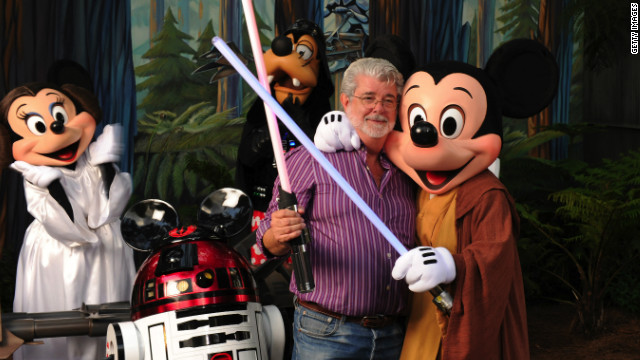
Last week Disney shocked the nerd world by announcing their intention to acquire LucasFilm and make Star Wars: Episode VII which is due in 2015. That news came right the heck outta nowhere.

My initial reaction (aside from shock) was something like “oh great, Disney’s going to ruin Star Wars now.” And then I remembered the horrible reality in which we live. The prequels happened. Clone Wars happened. Jar Jar Binks is a thing that exists. Oh yeah.

So given that reality and the recent-but-strange return of my optimism, I decided on a different outlook. Y’know what? All joking aside, this might be the best thing that’s happened to the Star Wars franchise since George Lucas decided to stop ruining making movies. Here’s why.

Production Pipeline

Disney has money. This we know. Well, now they have a few billion less after giving some to George Lucas. But, still. They’ve got mountains of cash. Disney also has a massive amount of capital in filmmaking. They’ve got studios full of creative people and loads of experience getting films made.

All of this is essential to making films. Science fiction films are generally more expensive to make than your average movie so it’s good that the studio has the cash to invest in the films.

Mo money mo problems or mo movies?

In addition to the new movies, we might actually get that Star Wars TV show that’s been kicking around since 2005. I would love that. Ever since SyFy canceled Stargate Universe just when it was getting good, I’ve been wishing for a new sci-fi show to watch. Apparently there are a bunch of episodes written for the show, but the problem has been money. Back in 2010 Lucas said that they couldn’t find a way to make the show for less than $50 an episode and they were waiting (again) for technology to catch up the vision and make the process cheaper. Perhaps with Disney at the helm this won’t be such a problem.

Of course quantity and more money doesn’t necessarily equate to quality. In fact, sometimes it’s the opposite. On the other hand, Disney and Lucas seem like they’re willing to seek out new directions and new talent.

New Blood

When I went to see Revenge of the Sith in 2005 there was a movie called Batman Begins showing in the theater next door. That movie along with Casino Royal and J.J. Abrams’ Star Trek showed that the idea of rebooting a franchise can be more than just a cynical cash grab. They can shed new light on old characters. Recast beloved stories in new contexts or just give another creative team the chance to tell the same story in their unique voice.

Star Wars needs a reboot. It does. The outline for a great saga is in the existing six films. It just needs to be made from the ground-up. It needs to be made in chronological order so everything cohesive. It needs to be made with the emphasis on story and character first and foremost.

Okay, so that’s my wild nerdy dream.

In reality we’re supposedly getting an Episode VII. And VIII. And IX. Okay. Some good could come of these as long as they don’t get overly ambitious and just try to tell a good story in an appropriate swath of the Expanded Universe. I don’t expect masterpieces. But this is a great opportunity for fresh new takes on the franchise. They just need to make sure to not hire some stary-eyed fanboy to do them. Actually, Disney is currently in talks with X-Men: First Class director Matthew Vaughn who seems like a good choice for the task at hand. Here’s hoping they give the job to the right person.

But if the whole thing does crash and burn and they’ve milked the Star Wars utters dry after Luke Skywalker Meets the Avengers, then they can reboot it and we can get back to great Star Wars stories.

Less involvement of George Lucas

As is the case with most nerds and Star Wars fans, I have love/hate relationship with George Lucas. Sometimes when I hear his name it conjures images of a young, pioneering filmmaker fighting heatstroke and budgetary concerns shooting on location in Tunisia. That guy was cool. He worked hard for something that nobody thought would succeed. He used models and practical effects. He took advice from others. And best of all, he knew that story was paramount. Don’t believe me? Watch this.

And that brings me to the other George Lucas that I think of. An older, fatter, less cool guy who seemingly disregarded everything his younger self had to say. This was a top comment on the above YouTube video:

“I’m very well convinced this person interviewed is not the same person who made those awful CGI infested, horribly written and acted Star Wars prequels as well as making those stupid unnecessary changes to the Original trilogy. My conclusion is that he was either adbucted [sic] sometime in mid 90’s and impersonated by an imposter [sic] who resembles him, maybe an evil twin brother, or a demon possessed him.”

You know what? For once a YouTube comment rings true. Actually, my theory is that the George Lucas who made the prequel trilogy is an evil clone, not an evil twin brother.

Clone George certainly seems to have fallen off the wagon of good filmmaking in recent years. With the release of the poorly-reviewed prequel trilogy and the poorly-received Indiana Jones and the Kingdom of the Crystal Skull, Lucas became a man whom some blame for reviving and ruining two classic franchises he helped create. Some have pointed to these works (especially to the prequel trilogy) to say that Lucas was never that great a filmmaker to begin with, but I have to disagree. There’s a reason that the original trilogy has a place in the hearts of so many and that is because it’s genuinely good (among other reasons). Lucas had a lot to do with that even though his role might have been exaggerated in recent years. One thing’s for sure: without him the beloved franchise wouldn’t exist in the first place.

Clone George Lucas had (from what I understand) basically total creative control of the prequel trilogy. Given the way those films turned out, it’s probably best that he’s taking more of a backseat in future Star Wars productions. Lucas wrote the treatments for the upcoming film trilogy and hopefully that’s the most input he’ll have over the process. Lucas has proven to be a pretty good ideas man in the past. You can see the outline of a great story in the prequel trilogy. He just struggles with the nitty gritty of writing those ideas into a script and directing actors effectively. A new trilogy plotted at a high level by Lucas but written and directed by others could be really exciting to watch.

Re-releases

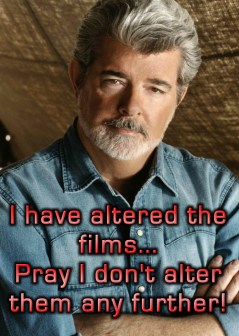
Speaking of George Lucas, one of the worst things he’s done aside from the prequels is to keep changing things in the original movies ad nauseam! From the first simple retcon of the 1977 movie’s title to the horror of the Blu-ray releases (and that’s not even mentioning the inevitable 3D release), the man just can’t leave well enough alone. For proof, see this extensive list of changes made to the movies in re-releases.

Some of the changes are just cosmetic – supposed “improvements” to the visuals using modern day computer graphics. A lot of people hate these changes and some others find them harmless. It’s the story changes that really irk people: the most heinous and well-known of them all is Greedo shooting first instead of Han Solo in A New Hope. And that’s not just nitpicking from overly-invested fans. It really does have an impact on the story and character arc of Han Solo throughout the trilogy.

But here’s the real kicker: even if you want a Star Wars without these changes, you can’t get it. It isn’t like there’s a “Director’s Cut” and a “Theatrical Cut” version you can buy. No. The only versions you can buy on Blu-ray and DVD are significantly altered. I actually don’t own any of the Star Wars films for this reason. The last time the original trilogy was released without the offending changes was on the 2006 DVD boxed set but unfortunately those versions were low-resolution with lackluster picture and sound quality.

The best thing about Lucas constantly messing with the films is that the updated versions do look nice. You know how you can tell when a movie’s from a certain era just by looking at it? The first time I saw the HD version of Empire Strikes Back I couldn’t tell it was shot in the late 70s and early 80s. The colors were vibrant, the contrast was great. It just looked really, really good. Similarly, the audio quality has been improved throughout the years. Personally, I have no problem with these kinds of changes. It’s the story changes and the extraneous silly stuff that really irks me and a lot of other fans.

Now with Disney in control of the property, will they do what fans have been wanting for years? Will they release an unchanged original trilogy with the proper restoration it deserves? Are you listening Disney? There’s money there, guys. You could even use that stupid “Disney vault” ploy to get us to buy it.

Remember, no matter what happens, it can’t really get worse.

Well. No. That’s not true, is it? That’s a failure of imagination.

Let me put it this way: it probably won’t get any worse and if it does it’ll be super entertaining.

See you at the theater in 2015!

The Election

Like a lot of people I hate election season. I hate the ads. I hate the rhetoric. The hate internet fighting over candidates. I hate the binary choice of two broken parties. I hate that people only see it as a binary choice. I hate that neither candidate will do anything to really fix or address the fundamental problems of the United States – even the ones they could effectively address as the country’s top executive.

This was the worst election yet for me. I had more debates with friends than I ever have before. Nasty ones at times. I hate how elections make people act. I hate the thinking it drives us to.

“If you aren’t for my candidate, you are a traitor.” “If you vote third party, you are voting for the ‘other’ guy.” “If you don’t vote, you’re voting for evil.”

I don’t even want to address that stuff at this point. I just don’t care about the debate over debate anymore.

At the end of it all I stand in front of the voting machine and stare blankly into the screen. It doesn’t ask me who I don’t want to elect. It asks me who I do. After all that build up it’s all over so quickly. I make my selections. I choose to the best of my ability and I walk out.

The rest is up to God. The results are his will. I have done what I can to affect temporal, earthly politics. Now, finally, I can go back to real life.

While I hate, hate, hate the conversation of modern American politics, I can’t really expect differently of most people. They are – most of them – unregenerate sinners who need Christ. I shouldn’t expect values like honesty and principle to govern their actions when they have so many incentives to forsake honesty and principle.

I’m really disappointed in my fellow Christians. Not all of them. But certainly some.

Romans 13:1-7 gives a succinct explanation of how Christians should relate to the government. We are commanded to submit to authority in scripture. We are commanded to show respect and honor where due. It is God who puts leaders in power.

Most scholars maintain that Romans was written sometime around 51 to 58 A.D. which would be during the reign of either Claudius or Nero. Neither of them were particularly nice guys and certainly didn’t have Christian values in their governance (especially Nero) and yet the Holy Spirit inspired Paul to write Romans with that passage about submitting to authority.

There’s a lot that could be said about this topic. It has a lot application in our lives. But here are the two points I wanted to make to my fellow Christians given that context.

1. When you disrespect people who hold offices in our country; when you make fun of them; when you misrepresent them as something they are not; when you see them as an enemy to be thrown out of office even if it means abandoning some of your principles to do it, are you in accordance with what the Word of God has to say?

2. Your reaction to whomever wins the election should be consistent with a deeply-held belief that God is in control of everything and that we are citizens of an eternal kingdom foremost and not an earthly country. It should make no real different to your Christian walk who wins this election (though practical life changes might occur). Does the Bible change depending on the result? Does God change? No. I know you know this. Act like it.

And I am not innocent in these things either. I had to stop watching the Presidential debates this year because I couldn’t stop myself from getting angry and disrespectful toward the candidates (and indeed the whole system and culture). There is a point at which disagreement turns to disrespect and I’ve crossed that line more than a few times. We have to learn to see our leaders for what they are: God’s instruments.

Politics is far less important than my patriotic American upbringing has led me to believe. That’s not an excuse for not participating (I did participate) but it is a reason for not having my heart invested in this thing. It gets ugly when I do that. It gets ugly when you do it.

truth of expression

“If you are yourself and you don’t become successful, the happiness that you get from creating something that is that truthful to yourself should be enough to propel you forward in life.”

– Justin Vernon

I’ve been listening to a lot of Bon Iver lately. I stumbled upon that quote in an interview with frontman Justin Vernon. Well, calling him the frontman is a bit of an understatement. He basically is Bon Iver.

I started listening to their stuff last December. As the cold weather returns I find myself going back to the record. Fittingly, the music goes well with the colder half of the year. The name is derived from the French phrase “bon hiver” which means “good winter.”

For Emma, Forever Ago is this really sad, wistful album. You can tell it’s about loss and past pain. It’s the best kind of guy-with-a-guitar singer-songwriter stuff. “For Emma” is one of the saddest songs I’ve ever heard in my life. It’s wonderful.

Bon Iver, Bon Iver is absolutely beautiful music from start to finish. I don’t know why. I think it’s freeing for some reason. It isn’t trying to be anything other than beautiful: not cool, not hip, not ironic. There’s way too much sarcasm and vitriol in society and in my own heart. I think that’s why it’s freeing. The final track is lead by this old style keyboard that sounds almost cheesy at first. But then you realize from the tone that it’s utterly sincere like the rest of the album. And like everything else it’s gorgeous too.

So, yeah, that’s my love letter to Bon Iver. Great stuff.

As for the quote, I’m finding myself more and more drawn to that philosophy and I think it must be the philosophy of the true artist.

The very best art in the world, I think, was done by artists being true to themselves. They aren’t gunning for fame and fortune. They’re just expressing whatever is on their heart. If it takes off, great. If not a soul responds to it at least they have created a true expression – something they can be happy with having done.

Athletic people work out. Analytic people analyse. Creative people create. We have to. It’s just this odd itch we need to scratch every once in awhile or else be unfulfilled.

For the redeemed person who is also a creative type, I would modify the quote a bit. We need to not only be truthful to ourselves in our expression but also to God and his truth. His ultimate truth. And you can do both.

To make expression true to your person is to indelibly stamp the work with your form – the form of a uniquely created individual. To make an expression true to God’s ultimate truth is to make it universal and pleasing to him. One without the other is not as good. It may even be bad.

Recently I finished a collection of lyrics which I am considering posting here soon. It took me years of work to create something I was happy with as a whole, complete collection. But I believe that it meets the two criteria listed above. Regardless of whether anyone else feels that it is of quality, I am happy with it.

If you are a creative type I’d highly suggest following these criteria as guidelines. If it’s true to yourself and true to God’s truth, then don’t listen to the critics or people that don’t get what you’ve done. But do yourself a favor and identify some trusted people who will keep you honest. It would be a grave error to express yourself in the voice of another, but it would be perhaps a bigger mistake to believe that you are the only one that matters in your art.

“We Accidentally Made a Film About Addiction”

If you saw that odd film I posted last week you might have wondered what the heck it was and how such a thing got made without quite a lot of illegal substances. Despite the title of this writing, I assure you there was no drug abuse going on.

In case you haven’t seen it yet you should probably watch it or this explanation won’t make any sense. Conversely, the movie won’t make much sense without this explanation. But watch it first anyway.

The Production

This whole thing started more than two years ago after I had finished a big project. I wanted to make something smaller, shorter and with easier production logistics. I hate logistics. That’s why I don’t aspire to be a producer.

The original idea was to make a mock “art” film even though I have never seen a real art movie. I seem to have a propensity toward spoofing things of which I have only the loosest grasp. Having said that, I think this probably is the truest to the thing I’ve tried to satirize before. But that’s largely because the term “art film” doesn’t mean very much. You can slap any old crap together and call it an “art film,” right? The less understandable, the better.

To that end, I followed the principles set out in the TV Tropes article “True Art is Incomprehensible.” (By the way, don’t click on that link unless you’ve got hours to waste – it’s TV Tropes for goodness sake!) Basically our idea was this: sad, depressing, and stuffed tiger shark.

The tiger shark was given to me for my birthday several years ago around the time this idea was coming together. Andrew, the lead actor, and I thought it would be a good prop. I mean, what’s more artsy than a depressed guy carrying a tiger shark? Ooh. I know! A depressed guy carrying a tiger shark in black and white with only the tiger shark in color.

That selective color effect is what took the longest time to achieve. Selective color, as it turns out, is an immense pain. There are, I’m sure, easier and better ways to go about it than I did. Even so, it’s a very time consuming process. It basically involved me having to cut out the orange bits of the shark frame-by-frame and then lay them back on top of the black and white footage. Unsurprisingly, this resulted in my cutting back on the number of shots using this effect quite dramatically.

Way, way back at the conception of this project, it was supposed to be a longer piece with more of an obvious plot. It involved the main character having memories of a girlfriend or wife or something who was gone or dead. I donno. Some depressing nonsense like that. We ended up scrapping this part of the plot partially because we didn’t think it would be prudent to strike so close to real life but also because I wasn’t brave enough to ask any girls to be involved. This thing is hard enough to explain now that it’s made. How would I have pitched it then?

It’s interesting to note that the tone of the film started out as complete mockery during the planning stages. Neither me, nor Andrew were feeling depressed in the slightest at the time. But by the time we got around to shooting last summer, we were identifying with the tone of the film far more than we had originally thought possible. A lot of the depressed staring into the distance is not acting. At least that’s what I maintain.

We ended up doing the whole thing in just three shoots in two locations. As I said before, God is the best lighting technician because we just used natural, available light for the entire shoot. Man, did we get some nice days for it.

This was the last project I shot on my old Canon Vixia HV30: a good camera for the money, but not professional by any stretch. I was rather impressed by the results. Still am, actually. From a cinematography standpoint, I was merely trying to get the prettiest images possible when shooting.

The original draft was a minute or two longer than the final version. I knew people wouldn’t want to put up with that kind of runtime. I wouldn’t. A few shots were cut. A lot were shortened. I like the pacing of the film myself, but I know it’ much slower than the average attention span is used to.

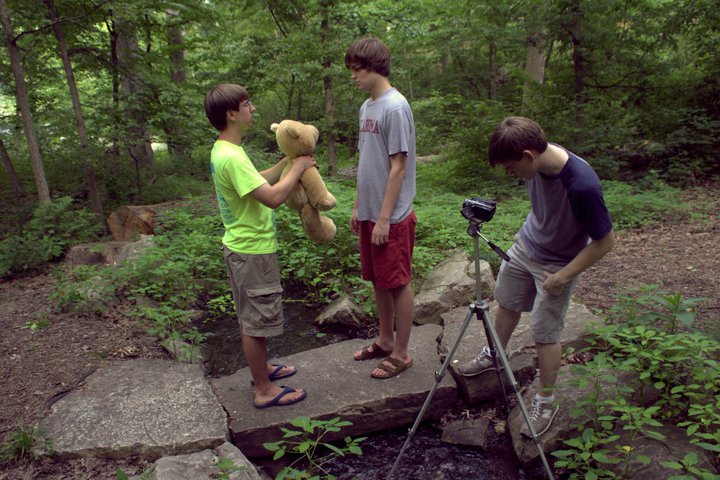
In the second shoot we did “the Destroyers” sequence. My intention was to deliberately create a “Big Lipped Alligator Moment” (warning: it’s another TV Tropes link!) and stick it right in the middle of an otherwise totally serene film. So we gathered all the assorted stuffed animals we could get and went to the park. I think the scene turned out to be very Kubrick-esque in that it makes no sense at all but you might think that there was some sense to be made of it if you were really deranged.

After wrapping the final shoot I sat on the footage for a year. I edited and re-edited it. I was never quite happy with any of the edits and I wanted to do that color effect that was so time consuming.

At the beginning of the summer I decided I was finally going to finish the film. My last idea was to record some terrible voice over for the film. Something really faux-poetic that didn’t mean anything and only sort of corresponded with what was happening onscreen. That idea came from the narration that was added to the original theatrical version of Blade Runner. The story goes that Ridley Scott and Harrison Ford didn’t want to put it in the movie. The studio forced them to anyway so Harrison Ford purposefully did a poor job on the recording. Narration obviously isn’t necessary in la possession du requin tigre either. That’s the joke. I mean, there was nothing to understand in the first place.

Or is there? Might have been wrong. Maybe.

A Possible Meaning

After I inserted Andrew’s voice over into the film I realized something surprising. I texted him: “I think we accidentally made a film about addiction.”

That was never intentional. But it seemed really obvious to me as I watched what I’d put together. With the narration it all seemed to become clear. It came to me like the interpretation of a song or poem.

The tiger shark was addiction of some kind. The main character thinks the tiger shark is his only friend when in reality it is keeping him from the outside world. He exists in this bubble of depression. When someone comes along to break him out of it – perhaps a friend, perhaps a random passerby – i.e. “The Destroyer” his array of animals banishes him to another realm of existence. In the end, he realizes he has to give it up. He fears being without it. What will fill the void of his addiction? Will he be alone instead? But he leaves it behind and ascends into the sunset and a brighter day.

Or something like that.

Is this a crazy interpretation? I don’t know. Maybe.

Like I said, it certainly wasn’t intentional. Honestly.

I had Andrew pick a leaf and drop it because it seemed like a pathetically artsy thing to shoot. I had him walk into the sunset because it was cliche and looked pretty. I think if anything the original intent (besides humor) was about depression and recovery. But addiction seemed to bubble to the surface when I finished the film for whatever reason. And I think it fits better. Seeing the tiger shark as a recovery from depression doesn’t exactly explain the Destroyer scene in my mind.

Is it the height of pretension and arrogance that I’m discussing possible meanings of my own work? I hope not. I have nothing to be prideful about here and it was always my intention to make fun of pretension.

Still I think the fact that the meaning of this film got away from me and took on a bit of its own life is interesting.

I had an discussion with a friend some years ago about art interpretation. I was of the opinion that the viewer’s interpretation of a work is just as valid as the creator’s intent while he was arguing that, no, the author’s view is of the work is the most valid.

While I still generally hold to that opinion (although it is more nuanced than that brief explanation) I now find myself in the odd position of having created a work where my own authorial intent is no longer my primary interpretation. I guess that means I’m in disagreement with my past self which, given the process of making this film and the natural way in which time changes our perspectives, isn’t all that unusual. But it is an unusual phenomenon to live out in this way.

Of course the easiest thing to do is take this whole thing as a joke. Maybe it’s an unfunny highbrow joke; maybe it’s only funny if you know the people involved, but it’s a joke nonetheless. That’s how it was “supposed to be”.