On this episode of The Workshop, we talk about iconic roles that shouldn’t be recast (some of which have been anyway) and share some unpopular opinions.
After an extended absence during which I got married, we have returned to fulfill our #commitment to podcasting excellence. Join us as I give thanks that the wedding is behind me, we “recap” this year’s winter Olympics, and chat about Bible movies.
Also, I mis-remembered. Swanky Kong first appeared in Donkey Kong Country 2, but I had DKC3 growing up and that’s the game I remembered him from. Gotta get the important facts straight.
One night I was attempting to play some Destiny with a couple of friends. We accidentally created a podcast instead. It happens.
Whereas The Workshop is more of a general slice-of-life/cultural commentary kind of podcast, Bits Don’t Byte will have a decidedly more nerdy focus. Expect lengthy, deep discussions on various geeky subjects.
Case in point: here’s a 2 hour discussion of that there new Star Wars movie. It’s a bit of a controversial one, huh? This is a very, very spoiler heavy discussion. You have been warned.
Bits Don’t Byte features Joshua Kehe, his brother Ben, and yours truly, Matt Goldammer. Please enjoy.
Dunkirk is a $150 million experimental film in the guise of a blockbuster.
Dunkirk features horrifying events stunningly photographed and set to a concussive soundtrack
Writer/director Christopher Nolan has made a career out of crafting smarter-than-average crowd-pleasing movies that function as puzzles as well as dramatic stories.
But Dunkirk is something different when it comes to subject matter. It’s not a sci-fi, mind-bending adventure like Interstellar or Inception. It’s not a grounded take on a superhero like his Batman films. It’s not a non-linear character-driven drama like Memento or The Prestige (my personal favorite).
Nolan has historically locked down his film sets tight in an effort to prevent spoilers from leaking out. But with Dunkirk, a film based on the evacuation of nearly 400,000 British soldiers from France at the beginning of World War II, the story is already known – at least by the history books. It’s a story engrained in the British psyche.
Had the evacuation at Dunkirk failed, World War II would have gone very differently. Nolan’s film only gives hints of that greater context. It’s not much of a history lesson. You won’t learn a lot about what actually happened not because the movie is inaccurate, but because it’s focused on the psychological experience.
We leave sentences unsatisfyingly unfinished on this episode. Eric asks if and how much should music artists change their style over time. I recap my thoughts about a couple movies I saw: one good (Wonder Woman) and one so-bad-it’s-good (you’ll just have to listen to find out).
On this episode of The Workshop, we talk mostly summer movies – what we’re excited to see or maybe not. This was recorded a few weeks ago. Most of the movies we talk about are still in the future, but Wonder Woman came out last week and is pretty good for what it’s worth.
Also stick around for enthralling discussions about the highest tech of topics like virtual reality… and paper.
Kids these days probably don’t know about Homestar Runner and that’s a shame. Here is a Homestar Runner cartoon that probably has little appeal to anyone outside of the Homestar cult, but – hey – it’s the one I referenced during the episode, so it’s the one I’m posting. WATCH IT, KIDS.
While it’s not quite as genre-transcendent as The Dark Knight and not quite so emotionally resonant as Spider-man 2, Wonder Woman‘s a well above average superhero movie. The film manages to be thematically satisfying while also ticking all the usual superhero movie boxes. There’s a finely-tuned balance between humor and sobriety; action and character development. Oh, and there’s villain that actually works.
Wonder Woman is the DC Extended Universe’s first good movie. We’ve previously experienced the disappointing, sometimes laughable, sometimes lamentable Man of Steel, Batman v. Superman: Dawn of Justice, and Suicide Squad. I guess fourth time’s the charm?
On the other side, we’ve got the Marvel Cinematic Universe sitting at 15 films (it’ll be 16 in July with the release of Spider-Man: Homecoming and 17 with Thor: Ragnarok in November). I like the Marvel movies less than your average person, but I’d say about 5 of them are pretty good. The rest are mostly competent if uninteresting to me personally.
What’s interesting is the different ways these studios (and I supposed comic book publishing houses before that) have approached their craft.
The Marvel film empire has found success from entirely competent films, but rarely good films. There’s not a lot of depth in your average Marvel Cinematic Universe movie. Lots of times they function more as extended trailers for the next film in the franchise. But they get away with it over and over and over.
Marvel’s secret is likable characters. Not necessarily deep characters. Not challenging, complex characters, but really likable ones. I didn’t even realize how much I liked these characters at first, but they kept me coming back despite often being disappointed by the movies built around them.
DC, conversely, has done a notoriously bad job with its characters beginning with the absolute butchery of Superman in Man of Steel. And I think that’s the main and perhaps only real problem of DC’s films before Wonder Woman. Audiences forgive all kinds of ills if they are presented with likable characters to follow.
DC has been criticized widely for being dark, brooding, and generally lacking in fun. I would say last year’s Batman v. Superman was the height (or the low point) of this. It left me impressed by the visuals, but utterly cold otherwise. It presented a world not worth saving and superheroes who didn’t seem to believe in much of anything. None of them were likable (with the exception of Wonder Woman’s cameo – but she was hardly a developed character in that movie.)
While DC lacks in characters, there is a certain ambition on display in these films – a visionary flair. There’s a grandiose air about them. They skew closer to myth than Marvel’s utilitarian filmmaking.
DC movies desperately want to be About Something. This has lead to grander and more spectacular failure, of course, but you can’t deny the effort. There’s real vision and passion behind the messy final products.
Marvel’s lack of ideas and themes really bores me. Those movies don’t say much of anything about the world, human nature, history, politics, science, spirituality, or even about the heroes themselves. And on rare occasion that a Marvel movie does contain thematic elements (like the surveillance state in Captain America: The Winter Soldier or artificial intelligence in Avengers: Age of Ultron), they’re never developed, never fully formed thoughts.
Sure, sometimes it’s nice see a piece of escapist fiction that doesn’t remind you of real life. But I think it’s cowardly and disingenuous to keep making movies ostensibly about heroes doing good in the world if you’re never saying anything about the world.
Wonder Woman is comparatively a poignant statement about human nature while also being entertaining mythmaking. This film shows that likable characters and interwoven thematic content in a superhero movie works extremely well. I hope we see more like this.
In this episode of the Workshop Podcast we drone on for way too long. Let you ears witness more bad business ideas, fancy coffee talk, and what things we *might* be pretentious about! Also stick around while we complain about social media (like everybody else) and discuss the movies we wish they’d make and the ones we wish they’d stop making.
2013 was a bad year for sci-fi. There were a lot of sci-fi films with potential that just didn’t pay off. I saw a few of them in the theater and none were really satisfying.
I went to see Oblivion because a group of friends was going and I like my friends more than I dislike Tom Cruise. And while I admire Oblivion’s restraint in the action and pacing departments, the script was riddled with the screenwriting equivalent of explosions: dumb, pointless plot twists. None of it made any sense but they were hoping the audience wouldn’t notice in the moment.
I wish this had been an Elder Scrolls movie instead. Also, the actress on the left looks like Chell from Portal. A Poral movie would have also been preferable.
Most of the group thought it was okay. A few thought it was boring and a few liked it outright. But I’m guessing that all of them have virtually forgotten about it now. I haven’t because I found it so offensively vapid and boring that it kind of stuck with me. That’s what you call ironic.
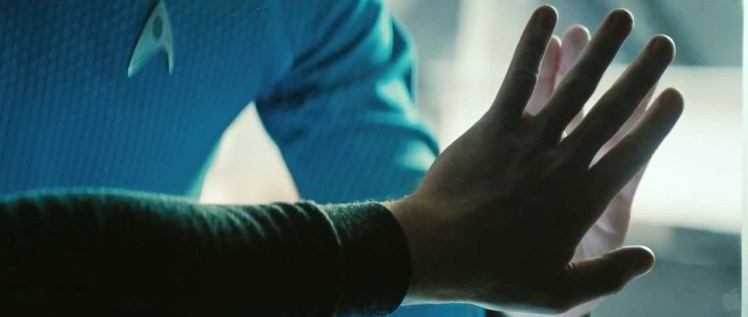
I had high hopes for the sequel to the 2009 semi-reboot of Star Trek. I cordially like the 2009 movie even though there’s not a lot going on under the surface, it still did a lot of things right.
I cannot say the same for Star Trek Into Darkness. I hated this one. I don’t mean to be a hater, but I can’t help it. Instead of a proper story (Star Trek-appropriate or otherwise) we got a set of action scenes, references to older, better Star Trek stuff, and Benedict Cumberbatch playing a character named Khan who wasn’t anything like Khan.
Borrowed pathos – this movie tries to invoke the feelings stirred by the best moments from old Star Trek and fails miserably
Into Darkness is bad on almost all non-technical levels. I have so many problems with this film that it’s not even worth going into. The screenwriters thought they were being clever by ripping off Star Trek II – the real Star Trek II. Sometimes reusing ideas works but here it just comes off as bad imitation. And it’s imitation without purpose or thought.
If I judge the movie on its own merits, it’s not very good. It’s shallow and empty and doesn’t do as much with the characters as Star Trek 2009 did. But if I judge it as part of the greater Star Trek canon (and the writers seem to be begging me to do this with their constant references and callbacks) then it’s a horrible, derivative mess. I left the theater offended and annoyed.
I had a passing interest in Elysium, the sophomore effort from District 9 director Neill Blomkamp, but I lost the interest as soon as I saw the trailer. Reviews and word-of-mouth affirmed my lack of interest. Detractors cite its heavy-handed political commentary as a negative. I have no problem – theoretically – with movies that borrow current political issues for themes, but I have rarely seen it done well. Subtly is the name of the game. In Elysium it was not subtle unless I was very deceived by the trailer and other commentators.
My biggest sci-fi hope for the year was Gravity. I already talked about that in another post. If anything, my feelings about the movie have further cooled since I’ve seen it. I really don’t care if I ever see it again. It had no story. I didn’t really even have ideas. It also failed to connect with me emotionally. It was just a ride. If I want that sort of experience, I’ll go play a video game where I have some level of input into what’s happening.
There’s quite a few smaller sci-fi films I didn’t see but I indent to. I fully admit it’s possible there was a really good sci-fi this year that slipped under the radar. But the big names disappointed.
Fortunately, 2014 will bring us some more sci-fi movies with potential. Hopefully more of these will turn out well.
Christopher Nolan’s longtime director of photography, Wally Pfister, is taking the reigns of his first movie. Transcendence starring Johnny Depp and Rebecca Hall is ostensibly about the technological singularity – a theoretical event where artificial intelligence surpasses human intelligence. This has been a plot point in a lot of fiction before, but Transcendence will attempt to guess what this might look like in the not-too-distant future of our modern world. Check out the trailer below.
Again, I don’t want to be a naysayer, but I am highly skeptical of the film industry’s ability to handle technology – and particularly artificial intelligence – in an interesting or remotely realistic way. It doesn’t happen very much.
I have two major problems with this trailer. One: the movie purports to be about the singularity but the plot actually seems to be centered around a character uploading his consciousness into a computer. That’s really not an exploration of superintelligent AI then, is it?
My bigger problem is that the whole thing seems to devolve into stupid action tropes by the end. There are lots of other ways an advanced AI would change the world besides causing lots of violence. We’ve seen computers go rogue before. The computer being evil twist has been done in countless other films. I was really hoping for something new and different.
I don’t have a problem with action movies – I really don’t. I have a problem with action films passing themselves off as something more intelligent when there’s really nothing to them. Why do so many sci-fis also have to be action movies? Why can’t they just be about ideas and characters and choices? Why can’t they be subtle and take their time anymore?
I really hope the trailer is just showing all the action to get people into the theater and that the movie itself is actually a lot more thoughtful than it appears here.
But I doubt it.
A bit more promising is the new X-men film: Days of Future Past. I’m cheating a little with this one. It’s probably more of a superhero film than a sci-fi, but since the plot revolves around time travel I’m going to say it’s close enough.
I really like this trailer a lot. Why? Because it’s about characters rather than action. I can sort of sense where the movie might be going, but I haven’t had the plot explained to me with clunky, pieced-together exposition. It makes me way more excited to see this movie than if it had just been a bunch of mutants fighting each other.
I always say X-men has the best central conflict of the big name superhero franchises. It’s great because our villain (Magneto) is right about human nature but his methods are morally wrong whereas our hero (Professor Xavier) is a bit overly optimistic – maybe a little naive – about humanity but his methods are morally admirable.
It’s easy to see how Xavier might have become jaded and hopeless after being betrayed by Magneto and crippled inX-men: First Class. It seems like it’s up to Patrick Stewart’s Professor X to redeem James McAvoy’s Professor X and restore sanity to the future. Or something like that.
The X-men film timeline is a bit of a mess right now. I’m not sure if they’re intending to fix that with a time travel story, but I like the idea of getting all these great actors in one movie.
And finally we have a sci-fi film from Christopher Nolan called Interstellar. Inception was arguably a sci-fi movie, but functionally it was more of a dressed-up heist film than anything else. This time around it looks like we’re going full science fiction – in space!
Interstellar is about… we’re not really sure yet. It’s a Christopher Nolan film and it’s a year away so details are scant. The teaser trailer provides very little information; in fact it’s mostly stock footage. Sadly, there is no space.
I’m up for a movie about interstellar travel and wormholes. Nolan’s films have been generally pretty grounded so it’ll be interesting to see how things go and what it’s all about.
Here’s hoping that 2014’s science fiction is more thoughtful than 2013’s!



 mattgoldammer.com