I just finished the latest Legend of Zelda game: A Link Between Worlds. When I first heard that there was going to be a sequel to 1992’s A Link to the Past which is widely regarded as one of the very best Zelda games, my inner cynic took note. I thought it was a really desperate move by Nintendo. They’ve been struggling to get the “hardcore gamer” audience back after neglecting and maybe even alienating them for basically the entire lifecycle of the Wii. What better way than to make a sequel to a 21 year old game, right?
I hadn’t bought a Nintendo game in many years. After hearing all the accolades for this game, A Link Between Worlds became my first purchase for the 3DS.
And it is good. It’s really good. I mean, it’s a Zelda game and most of them are pretty great.
A new year is upon us and that means it’s time to hand out meaningless accolades to various media properties because making lists is fun!
I am quite intentionally calling these “favorite” lists rather than “best of” lists because there’s a lot of games, movies, and music I didn’t experience in 2013 which no doubt deserve attention and praise, but I can’t consume everything in a year. With that in mind, I am limiting my lists to a Top 3 with possible honorable and dishonorable mentions.
The internet is awesome. I think we can all agree on that, right? Maybe…?
Sure, we complain about it a lot. We wonder what constant information and social media does to us as a species. But it would be seriously obstinate to insist that the internet hasn’t benefited us a great deal.
One of the best things about that internet is that it’s basically decentralized. Nobody owns it. Nobody runs it. That freedom has both positive and negative aspects, but in the long run, it has brought great innovations to all of us. Had the internet been a less free and open system it is possible that such innovation would have been stifled.
That freedom and openness is now in danger thanks to AT&T. Under the guise of consumer friendliness they’ve announced “Sponsored Data”. Companies can pay to have their websites and services not count against AT&T subscribers’ data plans.
Let’s say, for example, that Facebook pays AT&T for this. That means AT&T subscribers can use Facebook as much as they like without it costing them any precious data.
Sounds like a pretty good deal for AT&T customers, right?
Well, yeah. On the surface it seems like a pro-consumer move. In reality, this could turn out to be one of the worst things AT&T has ever done. And that’s saying a lot. With this move, AT&T is opening the floodgates for a non-neutral internet.
What the heck does that mean? Glad you asked.
Net neutrality is one of the founding principles of the internet. It basically means that all traffic on the internet is treated equally. Nothing gets greater priority than anything else. The internet has been and is supposed to be data agnostic. It doesn’t matter what website is loading. Internet protocol assigns them the same priority. The network itself is neutral.
This means that a multi-billion dollar company like Google doesn’t have an inherent advantage over somebody hosting a website from a homemade server in their basement. Sure, Google’s money counts because they can afford faster servers, more servers, and advertising campaigns. But there’s nothing about the structure of the internet that gives Google (or any other giant company) a fundamental advantage.
AT&T’s new plan will change that. AT&T subscribers will no longer have access to a neutral internet. Sponsored Data will train consumers to prioritize “Sponsored” websites – websites who have paid for preferential treatment – over other websites.
This sort of alteration to a network gives service providers a lot more power over the internet and their users than they currently possess. Suddenly we enter a world where to be really competitive online companies have to pay AT&T… and Verizon… and Sprint… and that’s just in the US! Were this trend to catch on in other nations, the cost of doing business would increase even more.
Given the importance of the internet to modern life, service providers should function like utility companies: providing you with bandwidth and charging you accordingly just like electric, gas, and water. Sponsored Data is a step in the opposite direction. It puts AT&T (and other telecoms should they follow suit) in the position of a gatekeeper. If your company hasn’t payed the Sponsored Data tax, you may lose users to those who have. Think about how this might apply to political, social, or religious organizations. Censorship by another name is still censorship.
This isn’t about “haves” and “have-nots.” This is about creating an extra barrier to climb over in order to be competitive online. It’s completely artificial. This is a problem that doesn’t have to exist but it will entirely because of the greed and shortsightedness of telecommunications companies.
The neutral internet is a wonderful thing and it needs to be preserved. I’m generally not one for seeking government solutions, but that is what we need in this case.
A few years back the FCC ruled on net neutrality. Wired networks (i.e. the internet service you get at home) were required to be neutral, but wireless networks (i.e. the internet you get via mobile phone) were exempted as a compromise. That was a mistake. Wireless internet is a huge market and is only going to grow in importance.
We need Congress to act on network neutrality. That’s probably too much to hope for since Congress isn’t exactly an effective legislative body these days. And they haven’t been very good at writing laws concerning technology in the past. Don’t forget the massive armada of telecom lobbyists who will fight tooth and nail opposing such a bill. Unfortunately, the cards are stacked against the internet remaining neutral.
Please get the word out. If you value the internet as a tool, as a platform, or even just for the entertainment value – please tell your friends and tell your representatives in Congress.
I’ve already contacted my representative and both senators about this topic. I never do that, guys. That’s how serious I am.
2013 was a bad year for sci-fi. There were a lot of sci-fi films with potential that just didn’t pay off. I saw a few of them in the theater and none were really satisfying.
I went to see Oblivion because a group of friends was going and I like my friends more than I dislike Tom Cruise. And while I admire Oblivion’s restraint in the action and pacing departments, the script was riddled with the screenwriting equivalent of explosions: dumb, pointless plot twists. None of it made any sense but they were hoping the audience wouldn’t notice in the moment.
I wish this had been an Elder Scrolls movie instead. Also, the actress on the left looks like Chell from Portal. A Poral movie would have also been preferable.
Most of the group thought it was okay. A few thought it was boring and a few liked it outright. But I’m guessing that all of them have virtually forgotten about it now. I haven’t because I found it so offensively vapid and boring that it kind of stuck with me. That’s what you call ironic.
I had high hopes for the sequel to the 2009 semi-reboot of Star Trek. I cordially like the 2009 movie even though there’s not a lot going on under the surface, it still did a lot of things right.
I cannot say the same for Star Trek Into Darkness. I hated this one. I don’t mean to be a hater, but I can’t help it. Instead of a proper story (Star Trek-appropriate or otherwise) we got a set of action scenes, references to older, better Star Trek stuff, and Benedict Cumberbatch playing a character named Khan who wasn’t anything like Khan.
Borrowed pathos – this movie tries to invoke the feelings stirred by the best moments from old Star Trek and fails miserably
Into Darkness is bad on almost all non-technical levels. I have so many problems with this film that it’s not even worth going into. The screenwriters thought they were being clever by ripping off Star Trek II – the real Star Trek II. Sometimes reusing ideas works but here it just comes off as bad imitation. And it’s imitation without purpose or thought.
If I judge the movie on its own merits, it’s not very good. It’s shallow and empty and doesn’t do as much with the characters as Star Trek 2009 did. But if I judge it as part of the greater Star Trek canon (and the writers seem to be begging me to do this with their constant references and callbacks) then it’s a horrible, derivative mess. I left the theater offended and annoyed.
I had a passing interest in Elysium, the sophomore effort from District 9 director Neill Blomkamp, but I lost the interest as soon as I saw the trailer. Reviews and word-of-mouth affirmed my lack of interest. Detractors cite its heavy-handed political commentary as a negative. I have no problem – theoretically – with movies that borrow current political issues for themes, but I have rarely seen it done well. Subtly is the name of the game. In Elysium it was not subtle unless I was very deceived by the trailer and other commentators.
My biggest sci-fi hope for the year was Gravity. I already talked about that in another post. If anything, my feelings about the movie have further cooled since I’ve seen it. I really don’t care if I ever see it again. It had no story. I didn’t really even have ideas. It also failed to connect with me emotionally. It was just a ride. If I want that sort of experience, I’ll go play a video game where I have some level of input into what’s happening.
There’s quite a few smaller sci-fi films I didn’t see but I indent to. I fully admit it’s possible there was a really good sci-fi this year that slipped under the radar. But the big names disappointed.
Fortunately, 2014 will bring us some more sci-fi movies with potential. Hopefully more of these will turn out well.
Christopher Nolan’s longtime director of photography, Wally Pfister, is taking the reigns of his first movie. Transcendence starring Johnny Depp and Rebecca Hall is ostensibly about the technological singularity – a theoretical event where artificial intelligence surpasses human intelligence. This has been a plot point in a lot of fiction before, but Transcendence will attempt to guess what this might look like in the not-too-distant future of our modern world. Check out the trailer below.
Again, I don’t want to be a naysayer, but I am highly skeptical of the film industry’s ability to handle technology – and particularly artificial intelligence – in an interesting or remotely realistic way. It doesn’t happen very much.
I have two major problems with this trailer. One: the movie purports to be about the singularity but the plot actually seems to be centered around a character uploading his consciousness into a computer. That’s really not an exploration of superintelligent AI then, is it?
My bigger problem is that the whole thing seems to devolve into stupid action tropes by the end. There are lots of other ways an advanced AI would change the world besides causing lots of violence. We’ve seen computers go rogue before. The computer being evil twist has been done in countless other films. I was really hoping for something new and different.
I don’t have a problem with action movies – I really don’t. I have a problem with action films passing themselves off as something more intelligent when there’s really nothing to them. Why do so many sci-fis also have to be action movies? Why can’t they just be about ideas and characters and choices? Why can’t they be subtle and take their time anymore?
I really hope the trailer is just showing all the action to get people into the theater and that the movie itself is actually a lot more thoughtful than it appears here.
But I doubt it.
A bit more promising is the new X-men film: Days of Future Past. I’m cheating a little with this one. It’s probably more of a superhero film than a sci-fi, but since the plot revolves around time travel I’m going to say it’s close enough.
I really like this trailer a lot. Why? Because it’s about characters rather than action. I can sort of sense where the movie might be going, but I haven’t had the plot explained to me with clunky, pieced-together exposition. It makes me way more excited to see this movie than if it had just been a bunch of mutants fighting each other.
I always say X-men has the best central conflict of the big name superhero franchises. It’s great because our villain (Magneto) is right about human nature but his methods are morally wrong whereas our hero (Professor Xavier) is a bit overly optimistic – maybe a little naive – about humanity but his methods are morally admirable.
It’s easy to see how Xavier might have become jaded and hopeless after being betrayed by Magneto and crippled inX-men: First Class. It seems like it’s up to Patrick Stewart’s Professor X to redeem James McAvoy’s Professor X and restore sanity to the future. Or something like that.
The X-men film timeline is a bit of a mess right now. I’m not sure if they’re intending to fix that with a time travel story, but I like the idea of getting all these great actors in one movie.
And finally we have a sci-fi film from Christopher Nolan called Interstellar. Inception was arguably a sci-fi movie, but functionally it was more of a dressed-up heist film than anything else. This time around it looks like we’re going full science fiction – in space!
Interstellar is about… we’re not really sure yet. It’s a Christopher Nolan film and it’s a year away so details are scant. The teaser trailer provides very little information; in fact it’s mostly stock footage. Sadly, there is no space.
I’m up for a movie about interstellar travel and wormholes. Nolan’s films have been generally pretty grounded so it’ll be interesting to see how things go and what it’s all about.
Here’s hoping that 2014’s science fiction is more thoughtful than 2013’s!
I don’t know much about Flannery O’Connor beyond what the article mentions. Nevertheless, two things immediately stuck me as I read this and I think they’re worth noting.
One came as I read this:
“Some of our worship services are so clean and antiseptic, led by grinning preachers and praise bands, talking about how happy Jesus makes us, that we forget that the Spirit prompts us to “groan” at our sin and the suffering all around us… Some Christians, then, can wonder if something’s wrong with them when they feel as though God seems distant, or when, despite all the smiles at church, they still feel guilty for the way their hearts don’t seem to match up with their hymns.”
A hearty “amen” to that! I wish I could say I don’t relate, but I do. And right now it’s where I live.
On the one hand, I understand we need to strive for excellence. We shouldn’t get bogged down in our own sinfulness or the suffering of the world. But there’s got to be a better balance for our culture.
Sometimes we fail to compassionately meet people in their struggles. Isn’t it easier (and ostensibly correct) to just tell people to find their happiness and joy in Jesus? But what if our hearts are having difficulty being gladdened by that truth day to day?
Second point: I found this article really refreshing. Why? Because it’s one Christian praising the work of another Christian even though they don’t line up theologically on major issues.
O’Connor was Roman Catholic while Moore is a Southern Baptist. Those positions are pretty far apart yet Moore recognized something in O’Connor’s work that he saw as helpful to those in his tradition.
This shouldn’t be surprising or refreshing, but it is.
How often do we read about petty infighting instead of this kind of praise? In our noble quest for pure doctrine we’ve lost sight of our common ground. We’ve forgotten that as individuals we all have bents and we all overemphasize and underemphasize certain things. So do our churches and denominations.
Truth is truth, but Christ has many followers with many different perspectives. More often than not we have things to learn from other genuine believers – even those with whom we disagree theologically.
In the last year, Telltale Games has become one of my favorite game developers. They have, in my mind, supplanted BioWare as the foremost developer of mainstream, story-driven games.
For the uninitiated: Telltale makes episodic adventure games based on existing franchises. They’re shorter chunks of content that come out over a period of time rather than all at once. Usually a single episode about 2 hours long with 5 episodes in a season. They’re heavy on story, dialog, and simple puzzles. They aren’t “difficult” per se. It’s more about experiencing the story and characters rather than developing gameplay skills. It’s kind of like an interactive TV show or a choose-your-own adventure book, but less dumb than that sounds.
The company had limited success until recently. They made a lot of licensed games that were either based on obscure properties (like Homestar Runner or Sam & Max) or more well-known franchises like Back to the Future or Jurassic Park. The obscure ones didn’t sell as well because of their obscurity and the big name franchise games weren’t well received.
The first Telltale Game I played was Strong Bad’s Cool Game for Attractive People which, as a big Homestar Runner fan, I thoroughly enjoyed.
I will always love Telltale for finally giving us Dangeresque 3
Last year, Telltale had their breakthrough success: a series based on The Walking Dead. Many, including myself, consider it their 2012 Game of the Year.
Walking Dead changed things up a little bit. Over the course of the five episodes, puzzles were pretty much abandoned altogether. The main game mechanic became making choices. Who do you save? Who do you share your limited supply of food with? Who’s side do you take in an ugly dispute within your group of survivors? It might sound strange, but this works surprisingly well. It’s far more engaging than yet another zombie shooter would have been (…and was). In fact, it ranks as one of my favorite games ever.
I played the entire saga at once. I was completely enthralled the whole way through. The Walking Dead is perhaps the most gut-wrenching piece of media I’ve ever experienced, but the story blew me away and left me in tears. I love it.
Believe it or not some of the best moments of the game look like this
But I’m a little worried about Telltale now. Was Walking Dead just an anomaly or have they really figured out the magical mix of gameplay and game writing technique? We shall see. Season 2 premieres next week. I’m desperately curious how they’re going to pull off what they’re attempting.
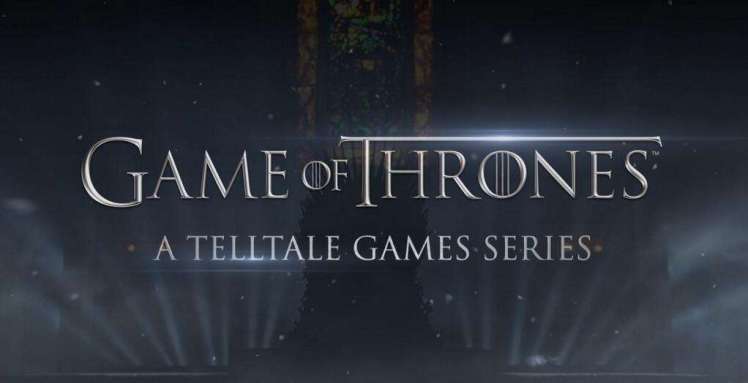
Recently, Telltale announced it will be doing two new series in the coming year: a series based on Borderlands and one based on Game of Thrones. With season 2 of the Walking Dead and the currently-running series The Wolf Among Us, it’s entirely possible that Telltale will have four concurrent game series come 2014. For a company that made only one game last year that’s quite a big leap in output.
This is what really has me concerned. Is Telltale biting off more than it can chew? They’ve hired a lot of new employees in the last couple of years. Rapid expansion is risky in any business but in a creative industry it can be especially problematic. They’re not building a bunch of new coffee shops or burger joints. They’re building story-driven franchise. They’re hiring people to make creative decisions and make things no one has ever made before.
Good creative products always require talent – not just money and manpower. That isn’t something you can just buy. You can hire people you believe to be talented, but it’s always a bit of a gamble. Quick growth means you have a lot of new blood that might not understand the culture and ethos of the your company and the products you’re trying to build.
Point is: I like the Telltale that gave us Season 1 of The Walking Dead and I hope their success and growth as a company doesn’t translate into a reduction in quality. I have no reason to think that yet. The Wolf Among Us is supposed to be great. I’ll be giving it shot soon.
As for the new games announced, Game of Thrones makes all the sense in the world. I don’t have any first-hand experience with the franchise myself. Never read it; never watched it, but from all I’ve heard it sounds like a great candidate for a Telltale-style adventure game. Making difficult choices and dealing with fascinating characters in life-and-death situations worked well in the Walking Dead’s universe. I’m sure it’ll work great in Westeros.
I am curious what story they’ll tell. By necessity it almost has to be some kind of side story. Obviously you can’t retread the events of the books because that will limit player choice and spoil the mystery of what’s going to happen.
With Walking Dead, there are as many stories as you care to tell: just make up a group of survivors. Maybe it’s the same way in Game of Thrones? I guess it could be similar. Sounds like more characters get killed off than in Walking Dead.
Tales from the Borderlands was the announcement that really surprised me. I guess in one way it makes a lot of sense: it really fits Telltale’s established art style. But when I think of Borderlands story is waaaaay down on the list of reasons to play it. It might not even make the list.
Borderlands 2 executed its story about 1000 times better than the first game, but that was kind of irrelevant. As long as the game had a billion guns and some wacky dialog we would have played it.
I just wouldn’t have thought of this as a franchise ripe for storytelling. I’m sure it’s possible to make something enjoyable out of it. The tricky part will be getting players to care about the world and the characters. They’ve all been pretty disposable up to now. Amusing distractions in between shooting stuff, but that’s it. My guess is they’ll go for comedy over drama. That’s probably good route to take because all of their other licenses are likely to play out as tragedies. Not everything has to be as emotionally gripping and meaningful as season 1 of The Walking Dead. According to the trailer, a lot of people are still going to die in this one, but at least Handsome Jack’s laughing it off.
Reflektor is one of the best albums of Arcade Fire’s career. Then again, the same could be said for any of the band’s releases. Exactly how the new double-album stacks up against the rest of the band’s discography is up to the listener to determine. I’m still not sure, but I’m willing to say Reflektor is in the running as their best album. And that’s saying a whole lot.
I was a bit befuddled back in September when the title track was released as a single. Clocking in at 7:30 minutes, the neo-disco tune “Reflektor” is a nice illustration for my experience with the album as a whole.
My first impression was incredulous – even skeptical.
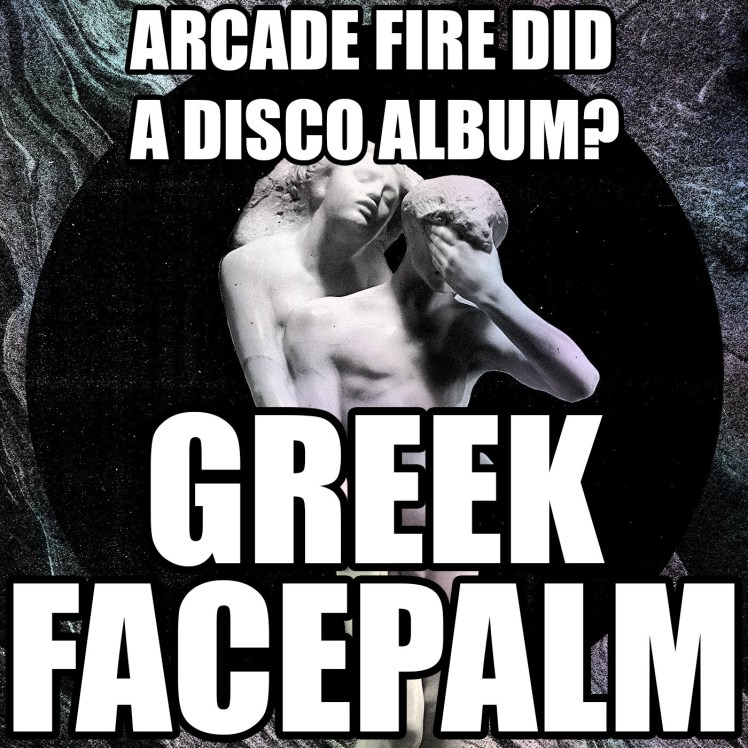
Disco. Really? I don’t hate or even dislike disco, but I really questioned the direction AF was taking with this new single and I worried that it was indicative of the whole album.
Also disconcerting was the news that Reflektor would be a double album. The Suburbs, much as I like it, is pretty long. It’s a bit too long at times and it deters me from listening as often as I might otherwise. How could they have made an even longer album?
Then about a week after the single dropped I gave it another chance. After all, this is Arcade Fire. They’d always been great before. Maybe I just needed to let it sink in.
Yep. I guess that was it.
After that I was hooked. I played the song again. And again. And again. Seven and a half minutes and I listened over and over.
And that was pretty much my experience with the album too. My first listen left me kind of cold and unimpressed. But Reflektor (the album) came alive to me on my second listen. And my third. And forth. Et cetera.
Yes, the album is long, but like the title track, it justifies its length… mostly. Reflektor is the most obviously disco-influenced song, but that vibe permeates a lot of the album most notably “Afterlife.” There are quite a few songs that wouldn’t sound out-of-place on AF’s other releases. “You Already Know” would have been quite at home on The Suburbs and “Here Comes the Night Time” doesn’t sound too far removed from the sounds of Funeral.
But there’s plenty of new ground broken here. For some long time fans that might be a turn off. “Flashbulb Eyes” and “Awful Sound (Oh Eurydice)” sound like nothing the band’s ever done before. It’s all really good stuff and amazingly produced. There are a lot more synths and electronic instruments at work here. Really, the overall sound is sort of an extrapolation of “Sprawl II (Mountains Beyond Mountains)” from their last record which is great since that was the best song.
The one unfortunate miss for me is the final track “Supersymmetry.” It’s not a bad track, but it’s fairly minimalistic and never comes alive for me like the others. Since it’s the last song on the record it hurts the overall experience more than it might have were it placed elsewhere. Arcade Fire has a history of great finishes. “My Body is a Cage,” “In the Backseat,” “Sprawl II,” and even “Vampire Forest Fire” are among their best songs. It’s a shame they couldn’t stick the landing on this album quite as well.
On the lyrical side of things there’s a lot going on. The Greek myth of Orpheus and Eurydice is a major influence especially in the album’s second half. The first disc, on the other hand, seems more dedicated to exploring the affect technology has on people in our “reflective age.”
I can’t pretend to “get” all the songs yet, but I love the fact that there’s more going on under the surface. Certainly one could accuse the band of pretension and I won’t argue against that. If I were not so enraptured by the music, my inner cynic might have dismissed all this Greek myth and modern age commentary as Arcade Fire trying to sound smarter than they really are.
But I like the music. At the end of the day, that’s what matters for me. The album is sonically and thematically cohesive. And the music good. Really good.
Reflektor left me asking myself why I ever doubted Arcade Fire. They’re pretty good at this music thing.
Once a journalist, Paul Greengrass changed careers and entered the film industry. He became a director and proceeded to make a career of doing movies about about tragic events. His films Resurrected, The Fix, Bloody Sunday, United 93, and now Captain Phillips are all “based on a true story.” Most audience members probably only know Greengrass as the director of The Bourne Supremacy and Ultimatum.
Greengrass brings his experience as a director of those action thrillers to bear on the story of Richard Phillips and the crew of the cargo ship Maersk Alabama who are beset by Somali pirates. It’s quite a marvel that I was brought to the edge of my seat watching the story unfold. After all, those of us who remember the news stories from a few years back have already had this “spoiled” for us.
Greengrass’ signature handheld “shakycam” style seems befitting for a movie set largely on the high seas. The direction is really superb and the action engaging. It all feels very authentic.
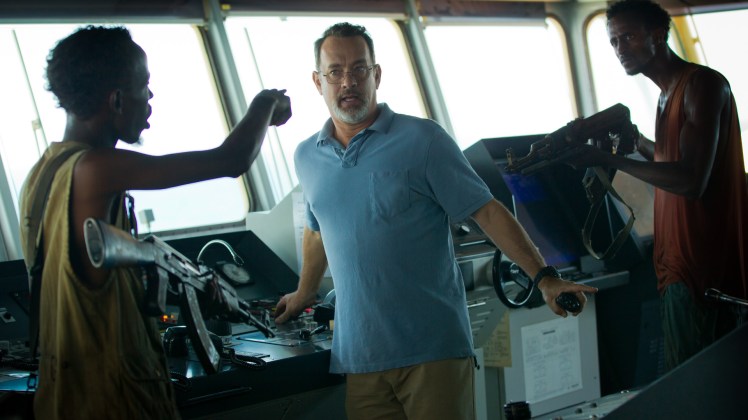
But the best thing about the movie is Tom Hanks as the titular Captain. At first I was really bothered by the odd New England accent he was affecting. It’s true-to-life but I’ve heard Hanks’ real voice so many times in other roles that it sounded put on. By the time the pirates were spotted on the horizon I had adjusted to it. When the emotional close of the film rolled around, I was completely sold on Hanks in the role.
As a movie, I really like Captain Phillips. It’s effective, well-paced, and Tom Hanks turns in one great performance as the lead. It portrays the whole event as being pretty unfortunate for all involved. It’s not waving a lot of American flags nor portraying the U.S. as some kind of bully.
The story is a sad one. Out of desperation and greed a couple young Somalis got themselves into the crosshairs of U.S. Navy SEALs where they stood no chance of survival. Although frightened for his life, Captain Phillips is also aware that the Somalis are doomed once the Navy shows up and practically begs them to let him go so they won’t get themselves killed.
I really appreciated how the event was handled. Except for one thing…
Hey, remember how I mentioned that Paul Greengrass did the second and third Bourne movies? The great thing about them is they were entirely fictional. Unfortunately, to properly consider and discuss this movie, we have to look at how it compares to reality.
According to the movie, Captain Phillips was a paragon of virtue. He’s overly cautious about the threat of piracy. He’s shown as a brave and sacrificial leader. In a word: a hero. On the other hand, you get the impression that his crew has a little trouble lining up under their Captain. They’re actually portrayed as a bit lazy in one scene.
The real-life crew tells a different story. The real Captain Phillips was allegedly reckless, arrogant, and a liar when recounting the events of the hijacking. There’s some pretty harsh criticism leveled at the man. If it’s true, that’s really disappointing.
For me, that controversy does mar the film because it’s so concentrated on one man who may have been portrayed very, very inaccurately. Captain Phillips is a good movie for its filmmaking and acting, but when it comes to veracity I really have to question it. Then again, what do you expect from these “based on a true story” movies?
This summer was a disappointing time for films. Thankfully award season has started. From now until the end of the year is our best chance for movies that hit that sweet spot of artistic integrity and entertainment value.
Most people seem to think Gravity is the epitome of that. Naturally, I disagree.
Let me start by saying I was reallyreallyreallyreally excited for this movie. I love space. I grew up reading books about NASA and the space program. I love space movies. I’m a real sucker for them. I’ll enjoy the space stuff even if there’s not a great movie surrounding it.
I can say that Gravity is the best sci-fi of the year. It’s not inane and stupid like Oblivion and Star Trek Into Darkness. It’s not “just for fun” like Pacific Rim. And it isn’t preachy like Elysium.
So how is it, actually?
It’s very, very, very pretty. Look at that space! Space! Space!
The movie is an absolute marvel of visual effects and cinematography. The “camera” takes full advantage of the freedom provided by a zero-gravity environment. This leads to some lengthy free-flowing shots including the thirteen minute opening shot. Very impressive stuff.
Also impressive is the sound design. I love it when there’s no sound in space, but so few movies respect this basic scientific fact. Gravity cleverly maintains scientific accuracy here. It’s only completely silent a few times. Elsewhere, the silence of space is covered by radio chatter, breathing noises, the muffled sounds of objects contacting the astronauts’ suits, and an effective score. Fair enough.
I willingly saw this movie in 3D.
That never happens.
I’ve been an avowed 3D hater for years now, but I read in all the reviews that it was worthwhile so I gave it a shot. I worried during the previews that I’d made a huge mistake. For example, the preview for The Hobbit gave me a headache. It was way over the top. And maybe it was because my eyes adjusted or maybe the effect was more subtle in Gravity but I was actually fine with it. I would be interested to see the movie again in good ol’ 2D just for comparison, but I don’t regret seeing the 3D version at all.
George Clooney and Sandra Bullock star as astronauts who become stranded in space. The acting is good as you would expect from these two though I wonder if it might have been less distracting to have had lesser-known actors filling the space suits.
George Clooney is playing George Clooney. He’s charming and fun to watch. He’s also a hugely comforting presence in a very frightening situation. That both helps and harms the film. Bullock is the real star here. I’ve heard lots of people rave about her acting here and I find no fault in it, but it didn’t blow me away either. I never stopped seeing her as an actress in a movie.
I think the problem was the writing. In terms of dialogue – there’s not much of it, but there are things that really bothered me. Bullock’s Dr. Stone gets a bit of backstory that I didn’t connect with at all. It came off as a desperate attempt to get the audience to care about her. The film didn’t need that. I would feel sorry for my worst enemy if they were drifting alone in space. That is a completely terrifying thought.
The other distracting “problem” is the scientific accuracy. It’s really, really good in most places, but there are some egregious deviations from reality that, depending on how much you know about physics and space travel, may really pull you out of the movie.
Director Alfonzo Cuarón has freely admitted Gravity is not about being scientifically accurate. Some concessions needed to be made in order to tell the story. Okay, that’s fine. But there’s really not much of a story to tell. It’s a very basic survival story and that’s fine. But for me it isn’t a happy medium. I would have personally preferred either more science or more story.
For whatever reason, the film never really pulled me in. It is gorgeous to look at but felt distant from it most of the time. There were only a couple times I felt frightened or concerned. It didn’t ask me to invest much and I didn’t get much out of it. It was a fun ride. But it was just a ride.
Nevertheless, Gravity is absolutely worth seeing and I’m glad it’s done as well as it has at the box office. But for me it simply isn’t the transcendent experience I was led to expect and that other people are apparently having. In terms of effects and cinematography it breaks new ground, but it falls short of inspiring my imagination like other science fiction of the past.
Much has been said about the Star Wars prequels. Most of it negative. The internet loves talking about how awful they are, how much they missed the mark, how the writing’s no good, and what the heck was George Lucas thinking anyway?
Actually, I’m more annoyed with how Lucas has altered the old films than by the prequels themselves. It always seemed apparent to me that he was really trying even if he was also really failing.
Or did he fail after all?
The drama! The horror!
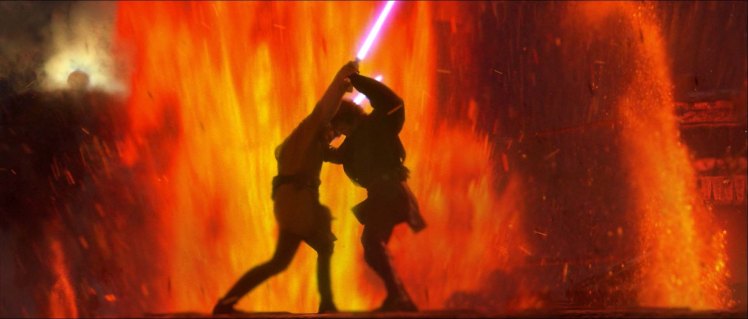
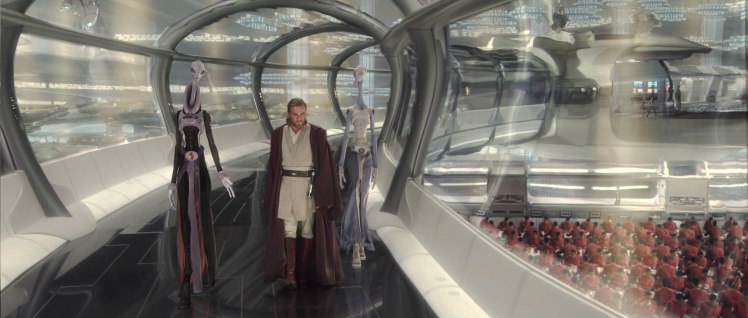
This post looks at Star Wars as visual art. By watching the movies on mute you take away the terrible dialogue and the awkward delivery of said dialogue. Remove the ham-handed scripts and these films become all about the imagery and what that communicates.
Film has so many aspects to it and not all filmmakers are great at wielding every element. For some, their strength lies in writing, plotting, and working with actors. George Lucas is infamously bad at all of those things. But the man has proven himself to be a master of visuals.
We can debate his focus on innovation over proper storytelling, sure. Did he go too far with GCI? Absolutely. Did it make the films terrible? No. It gave them a different aesthetic. We may like it or hate it, but I can’t deny that there’s a certain power in the visuals of Star Wars – even in the prequels.
It might not look real, but there’s certain fantastic quality to this shot
Like a lot of Millennials, I saw the original trilogy growing up. I watched them on VHS for the first time in the mid 90s and then saw the special edition re-releases in theaters. I was absolutely psyched when Phantom Menace came out.
I was also nine years old so I enjoyed it and thought it was good.
Remember these, guys?
After the prequels ended in 2005 with Revenge of the Sith, I started hearing the negative talk about the movies. As I listened to the criticism and my artistic and critical sensibilities grew and matured, I began to turn on the prequels as well. I saw them as terrible movies made by a man who had lost his way.
But I could never hate them. I could never bring myself to actually dislike watching them. They were still Star Wars to me – even if a sloppy, less-than-perfect Star Wars.
Reading this article reminded me why there’s definitely still some artistic merit to these movies. There are legitimate reasons to not write them off completely and to enjoy them for what they do well.
I’m probably not going to try the exercise of watching Star Wars on mute myself. I don’t really have the time for that. But by reading this post, I have gained a bit more of an appreciation for movies that I dearly wish had turned out better. It even helped me regain some respect for George Lucas. Despite what he’s done to the films in re-releases, the man is still a visionary and he’s gotten an immense amount of hatred for something that doesn’t really make an eternal difference to anyone.




 In the last year, Telltale Games has become one of my favorite game developers. They have, in my mind, supplanted BioWare as the foremost developer of mainstream, story-driven games.











 mattgoldammer.com